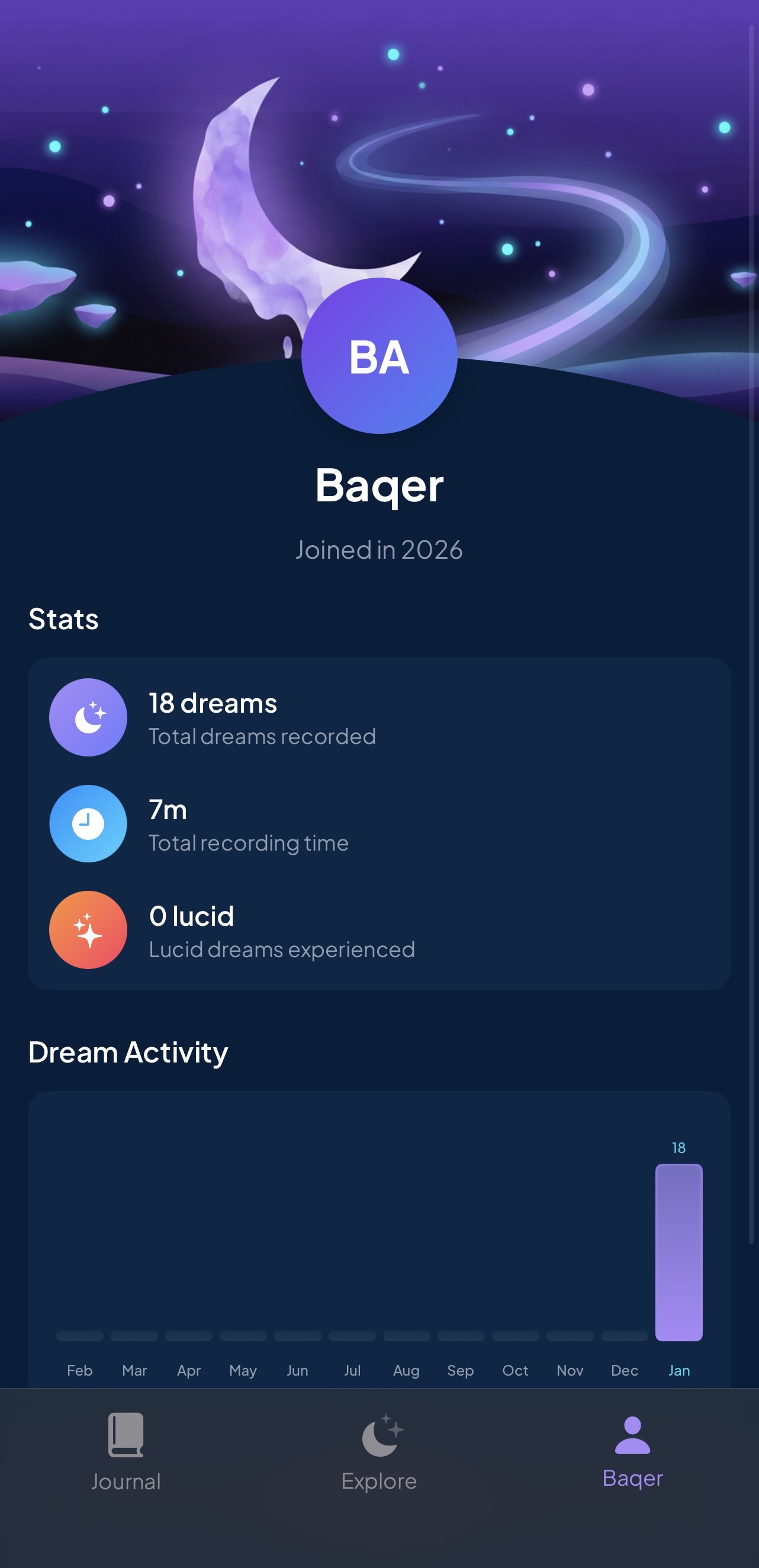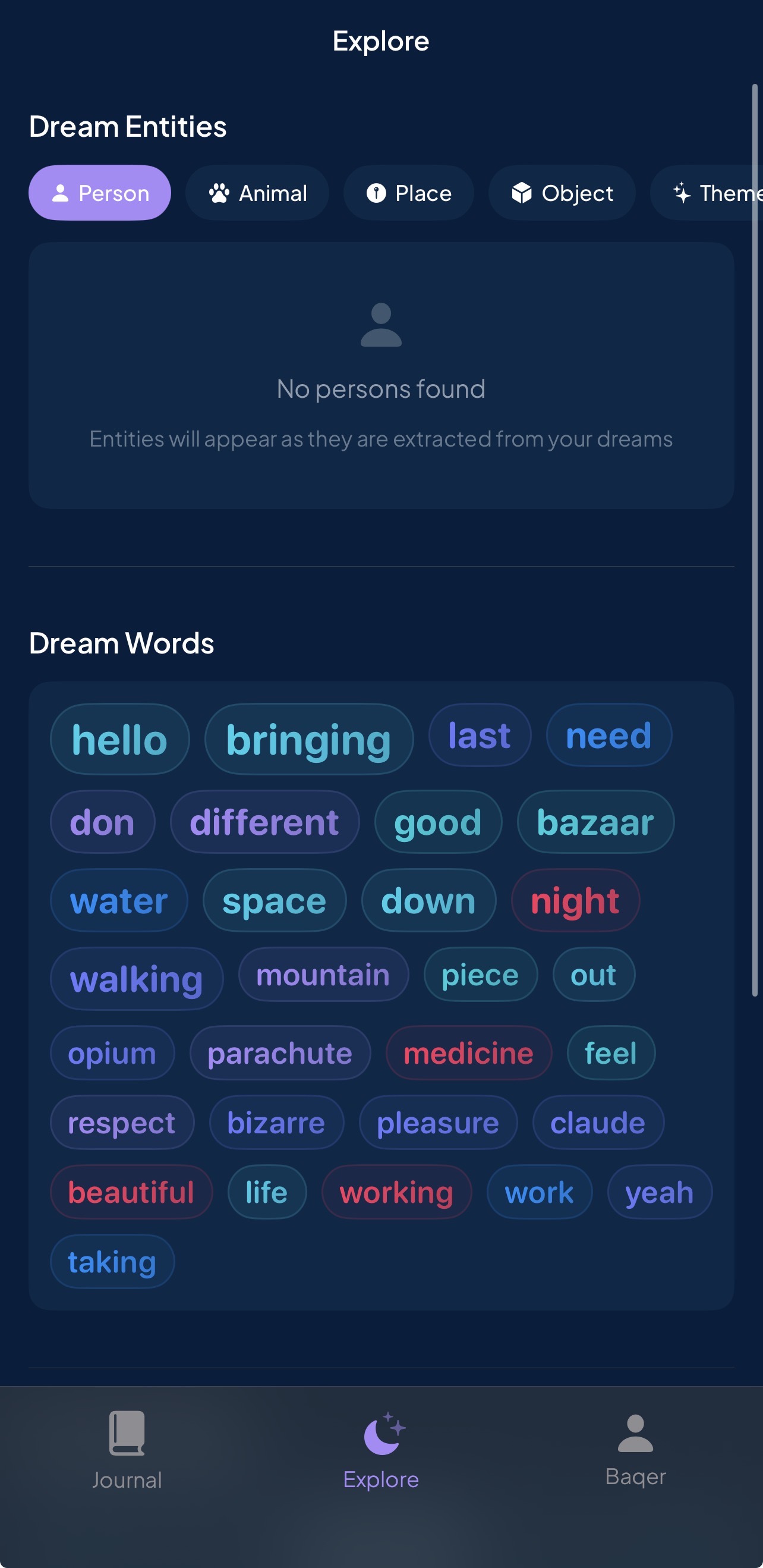
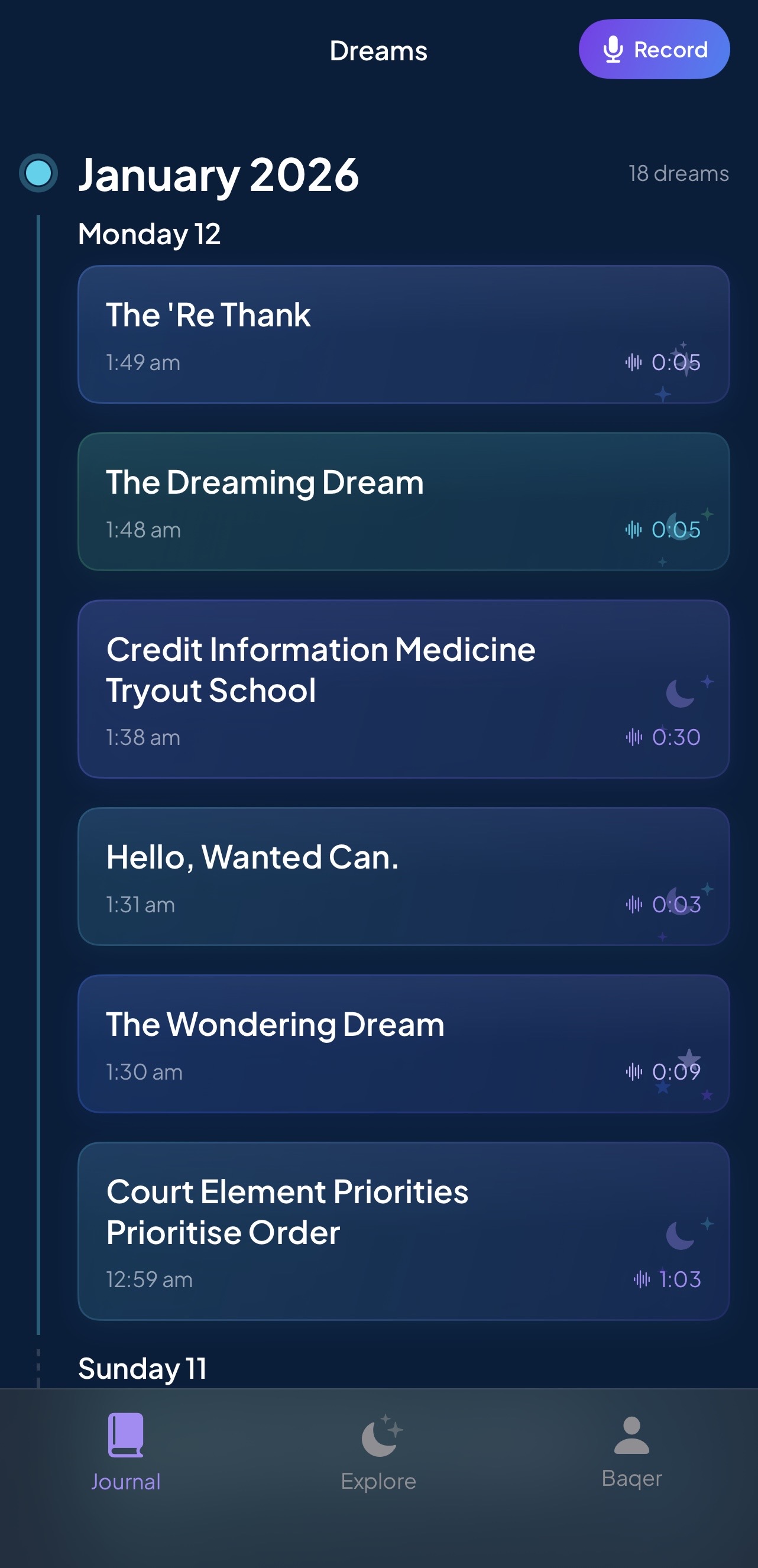
An AI-powered dream journaling app designed for the 3 AM moment, when you're half-asleep and typing is the last thing you want to do.
Role
UX Designer
Duration
2025 - 2026
Platform
iOS Mobile App
Tools
Figma, FigJam
Unsomnia is an AI-powered dream journaling app designed specifically for lucid dreamers and dream enthusiasts. The app addresses a fundamental problem: capturing dreams at 3 AM when users are half-asleep and typing on a keyboard is impractical.
Through voice-first recording with on-device transcription, users simply speak their dream aloud and the app handles the rest. The app automatically identifies and tracks recurring themes, people, places, and objects across dreams, revealing subconscious patterns over time.
Dream recall decays exponentially after waking. Research shows that within minutes of waking, details begin to fade rapidly. The friction of typing causes users to lose details or skip journaling entirely. Existing dream journaling apps require manual typing and tagging, which is:
The primary audience consists of active lucid dreamers who already journal daily. The lucid dreaming community is substantial, with over 615,000 members in r/LucidDreaming alone. Secondary audiences include dream enthusiasts interested in self-understanding, psychology, and personal growth.
Voice is Natural
At 3 AM, speaking is significantly lower effort than typing. The app must be designed for the half-asleep state.
Privacy Matters
Dreams contain deeply personal content. Users journal more honestly when they trust their data stays private.
Patterns Emerge
Individual dreams feel random, but recurring entities reveal subconscious patterns when tracked over time.
Low Friction = Habit
The interaction must be under 30 seconds: wake, record, sleep. Any added step reduces consistency.
Analysis of existing dream journaling apps revealed significant gaps in the market:
| Gap | Competitors | Unsomnia |
|---|---|---|
| Voice at 3 AM | None or requires setup | Native iOS Speech, instant |
| Entity extraction | Manual tagging | Automatic AI extraction |
| Pattern tracking | None | Entity graph across dreams |
| Onboarding | Signup required | Guest mode, full features |
| Privacy | Cloud transcription | On-device only |
28, Software Developer, San Francisco
Background
Active lucid dreamer for 3 years. Currently uses a notes app but loses details while typing. Interested in pattern recognition and self-discovery.
Goals
Capture dreams quickly before details fade. Track recurring themes without manual effort. Keep dream data private and secure.
Frustrations
Typing at 3 AM is slow and disruptive. Manual tagging is tedious and inconsistent. Worried about cloud services accessing personal dreams.
35, Therapist, Toronto
Background
Uses dream journaling as part of personal therapy practice. Recommends journaling to clients. Values psychological insights over lucid dreaming.
Goals
Understand subconscious patterns. Track emotional themes over time. Have a reliable, private tool to recommend to clients.
Frustrations
Existing apps feel gimmicky. Lacks tools for serious emotional/psychological tracking. Concerned about data privacy for professional use.
The design prioritises the 30-second interaction: wake, record, sleep. Every design decision was made to minimise friction while maximising the value captured from each dream.
One-tap recording that works instantly. Users simply speak their dream aloud, capturing rich detail without the friction of typing.
Audio is transcribed locally using iOS Speech framework. Voice recordings never leave the device, ensuring complete privacy for intimate dream content.
Automatically identifies people, places, themes, and objects. No manual tagging required, ensuring consistent pattern tracking across all dreams.
Tracks recurring entities over time, surfacing insights like "Mom appears in 23% of your dreams, usually with positive sentiment."
The user flow was designed to be as frictionless as possible, optimised for the half-asleep state at 3 AM.
User wakes at 3 AM, opens app, taps record
User speaks dream aloud (typically 2-5 minutes)
Transcription runs on-device (works offline)
Transcript saved locally; user goes back to sleep
AI analysis extracts entities and sentiment
Patterns become visible over time in Explore view
Accessibility was considered throughout the design process, not as an afterthought but as a core principle. The voice-first approach itself is an accessibility feature, making the app usable for those who struggle with typing.
Unsomnia is currently in the validation stage, with planned user interviews to confirm product-market fit. The MVP is targeted for App Store submission by end of March 2026, with launch in early April 2026.
615K+
Potential users in r/LucidDreaming community alone
$49/yr
Target subscription price point
Designing for 3 AM required completely rethinking standard UX patterns. The half-asleep user has fundamentally different needs than a fully awake user.
For sensitive content like dreams, privacy isn't just a compliance checkbox, it's a core feature that enables honest journaling and builds trust.
Manual tagging will always be inconsistent. AI extraction ensures reliable pattern tracking without requiring effort from the user.
I'd love to discuss this project in more detail or explore how I can help with your product.